February 24, 2026
Don’t increase your workload, increase your engagement.
This article explores the way in which technology can help and not hinder. It deals with student engagement as a central topic and explains how a new technology, Nearpod from Renaissance Australia can help teachers actually save time preparing lessons and, at the same time, foster an environment of engagement. This is done through a variety of computer-generated interactive activities that are created by Nearpod but informed by the teacher, combining a synergy between professional expertise and digital capability.
You’ve already got it!
So, why not make the most of it? Of course, I am referring to your expertise, experience and, above all, desire to engage with your students. Well, that’s easier said than done and every teacher would, quite rightly, roll their eyes and cite a growing list of teacher-tasks that eat away at whatever time they have to create ‘more-engaging’ lessons.
So, let’s just stop a minute and look at what we mean by ‘engagement’. Put simply, it’s the degree to which a student wants to interact with the material presented by the teacher.
An oversimplification, of course, especially considering the complexity of our modern classrooms in terms of their diversity, distractions, and fast-moving pace. Not to mention the actual time a teacher would need to have to design and re-design ‘engaging’ lessons that speak to each student and meaningfully ‘engage’ them. However, it captures the essence of the relationship between teacher intention and learner participation and that is always a challenging space!
The Australian government is engaged.
The Australian government, for one, has identified its importance to students and has launched its “Engaged Classrooms Initiative”, a $3.5 million investment over two years focused on improving the learning environment in schools and providing evidence-based guidance to help teachers create safe, supportive, and effective learning environments. It is one of many measures aimed at addressing the need for every student to be seen, heard and helped and highlights the need for a practical solution to be found in what can be an amorphous and student-specific space.
We are not alone – there is help at hand.So, we are all agreed that engagement is an essential element of the teaching and learning paradigm and not just a ‘nice to have’. However, more vexing is the “How to?” rather than the “Why to?” and, perhaps, we need to look to the future for help with that.
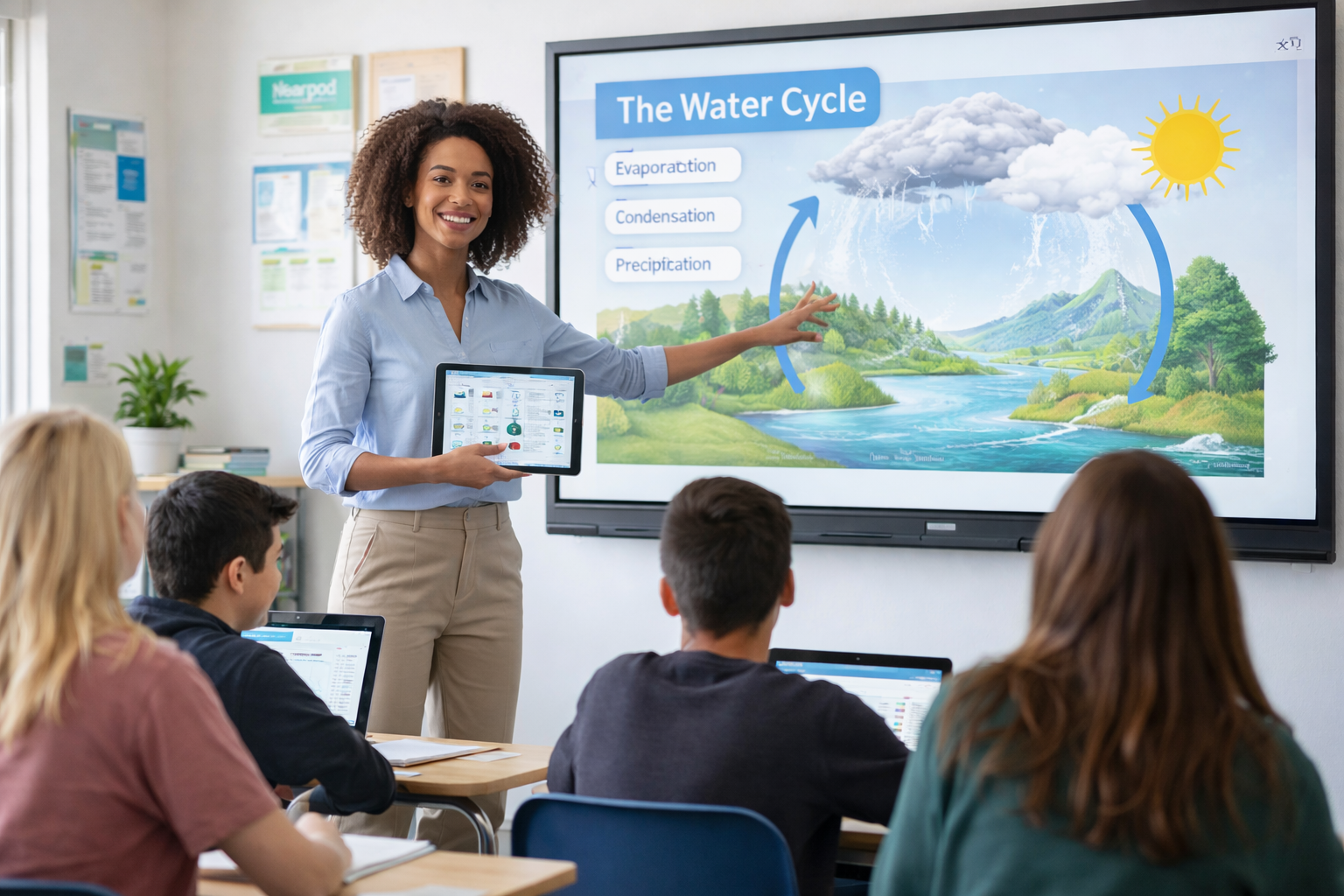
This is where products such as Nearpod from Renaissance Australia have been successful. Nearpod is a tool that allows teachers to achieve this level of interaction with students but without the need for the teachers to be ‘digital-experts’. In fact, those that use it simply ‘feed’ their existing material (Power Points, slides, documents, pictures, videos, etc…) into the software and it does the rest, presenting students with material they digitally interact with and the teacher with real-time data, allowing greater insight into their interactions.
When teachers can see live responses, they can react immediately, tailoring learning and providing support for all learners as the lesson unfolds or as part of a structured on-going plan. Through the lens of different media, students are given the opportunity to interact in ways that suit them, perhaps allowing less confident students to interact through messaging or drawing or to record responses or use collaboration boards.
Laura Hanna, a ‘self-confessed techno sceptic’, will never look back.
Laura Hanna from the University of Technology Sydney, was, like many teachers, time-poor but aware that technology was something that could help her engage with her students- if only she had the time to investigate it all. She didn’t need to, a colleague was an early adopter of Nearpod and allowed Laura to see and experience how it helped in her classes first hand. Fast forward to now and Laura cannot imagine teaching without using it as her means of delivery, connection and enhanced engagement with each student. Now, her existing Accounting material is simply transformed into material that is interactive, diverse and able to be delivered online, face-to-face or at home – all with real-time feedback on their interactions.
She tells us, “It gives me a really good diagnostic tool to see where the students are at and how I can help support them better.”
Paradoxically, Laura has discovered that technology, far from consuming her time, has gifted her time which she now uses to really see what her students are doing and engage with those elusive ‘learning moments’ that all teachers hope to find. Laura speaks about the “novelty” value of Nearpod’s variety and the fact that it “breaks-up” the class with interesting activities that keep the students engaged. She even points to the ‘little things’, like being able to manage the classroom through being able to see participation. Her “pet peeve”, as she puts it, is how more traditional question-and-answer methodologies can favour those students more able to think quickly and speak out while others, perhaps those from ESOL backgrounds or less confident students may want to participate but lack the ability to do so. Nearpod allows these students to find a way to let the teacher know that they are engaged and engaging.
Your own, personal teacher-aide – everyday!.
This kind of technology tool is not designed to write the lessons or curate the material, this is designed to create ways which give teachers the opportunity to focus on their students, allowing a synchronous window into their responses, interactions and levels of engagement.
This technology is a practical teacher-aide that transforms your material into a ‘bit-sized’ smorgasbord of interactive activities that keep the students involved, engaged and on-task allowing you to see what’s really happening and the students feeling that they are being seen.
As one student commented “I love it when you use Nearpod, thank you.”
It is unlikely that a cohort of teachers or students would take the time and energy needed to use a tool if they thought that a new method would be used the next time. Perhaps, then, a compelling argument could be made for schools to find and commit to a suite of tools that is comprehensive, informative and, above all, useful. As mentioned earlier Renaissance Australia’s suite of PASS, CAT4 and NGRT help schools build an early, evidence-based understanding of students and make informed decisions before issues escalate
So, within the noise, fun, excitement and, often confusion of day one, both students and teachers get their first glimpse of what the year ahead might look like. It can act as a snapshot of what lies ahead and, if the observations of those first days and weeks can be recorded and explored, then, the opportunity will not be lost.